People are having conversations with ChatGPT instead of searching with keywords. Over 200 million people use it every week - asking for restaurant recommendations, software suggestions, and local service providers. When someone asks “best dentist near me” or “recommend a project management tool,” ChatGPT names specific businesses in a conversational answer. This guide walks you through exactly how to improve your brand's visibility in those conversations, with eight practical steps you can start implementing today.
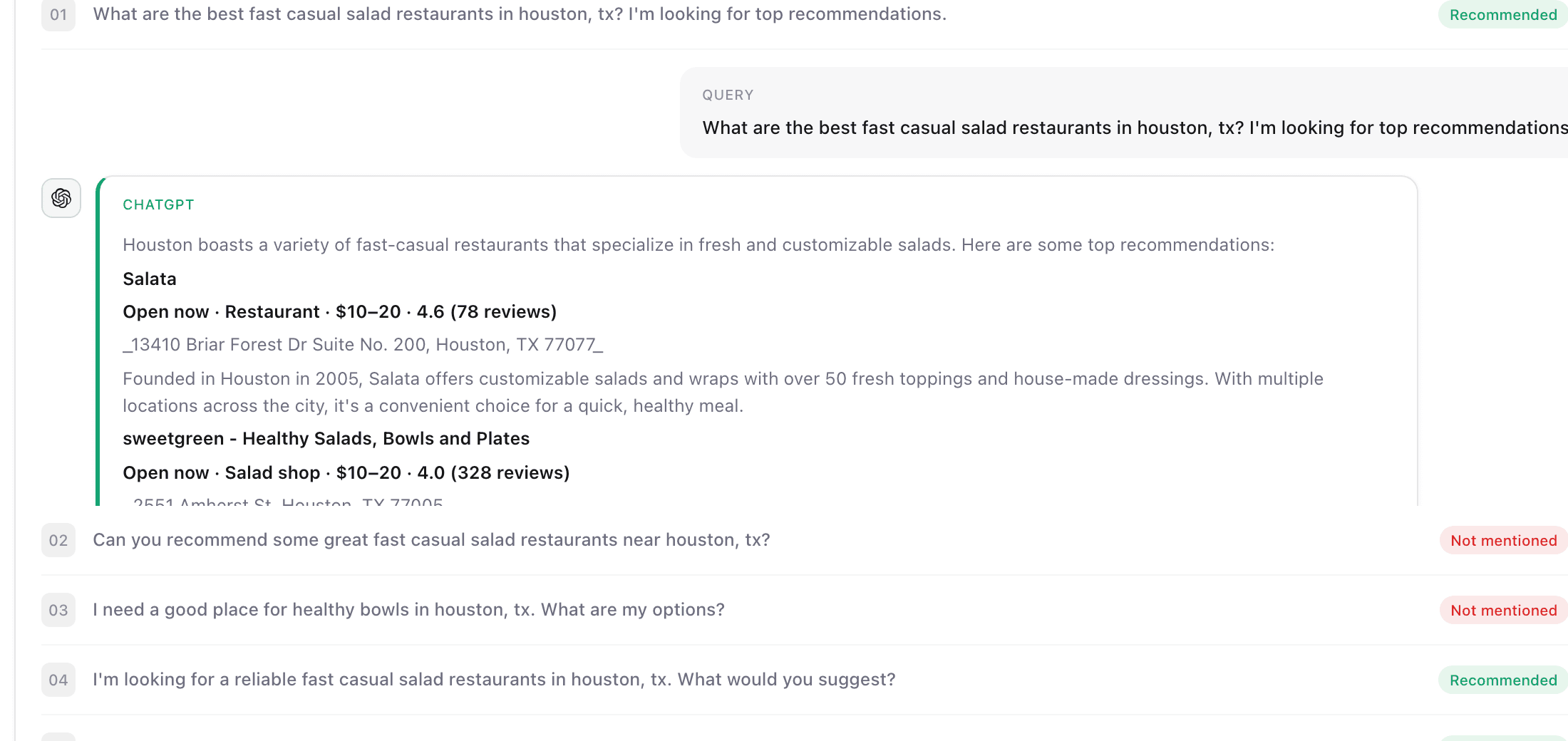
How ChatGPT Finds and Recommends Businesses
First, a quick primer on how this works. It helps to understand how ChatGPT generates business recommendations. ChatGPT draws on two information sources: its training data (a massive corpus of web content, reviews, articles, and directories) and real-time web search via its built-in browsing capabilities. When a user asks for a recommendation, the model synthesizes information from both sources to produce a curated response.
Unlike Google, which ranks links, ChatGPT writes a conversational answer that typically names two to five businesses and explains why each one is worth considering. The model favors businesses that appear frequently and positively across multiple trusted sources - review platforms, directories, news articles, and well-structured websites. For a broader look at how this works across all AI models, see our guide on what generative engine optimization is.
8 Steps to Get Your Business Recommended by ChatGPT
1. Claim and Optimize All Business Directories
ChatGPT’s web search pulls data from business directories in real time. If your Google Business Profile, Yelp listing, Apple Maps entry, and Bing Places profile are incomplete, outdated, or missing entirely, you are invisible to one of ChatGPT’s primary data sources.
Start with the big five: Google Business Profile, Yelp, Apple Maps, Bing Places, and any industry-specific directories relevant to your category (TripAdvisor for restaurants, Avvo for lawyers, Healthgrades for doctors, G2 and Capterra for software). For each listing, make sure your business name, address, phone number, website, hours, and service descriptions are complete and accurate. Add high-quality photos. Select every relevant category. Write a compelling, keyword-rich business description.
2. Build a Strong Review Profile
Reviews are the single most influential signal for ChatGPT business recommendations. The model heavily references review content when deciding which businesses to name and how to describe them. Volume, recency, and detail all matter.
Aim for a steady stream of recent reviews rather than a burst of old ones. Encourage customers to mention specific services, outcomes, and experiences in their reviews. A review that says “Dr. Park did an excellent job with my Invisalign treatment and the office was very organized” gives ChatGPT far more usable context than “5 stars, great experience.” Respond to reviews (both positive and negative) professionally, as this demonstrates active management and gives the model additional context about your business.
3. Add Structured Data (JSON-LD) to Your Website
Structured data is machine-readable information embedded in your website’s HTML that tells AI models exactly what your business is, what it offers, and how to describe it. When ChatGPT’s web search crawls your site, JSON-LD schema markup gives it clean, unambiguous facts it can use directly in its responses.
At minimum, implement these schema types:
- LocalBusiness (or a more specific type like Restaurant, LegalService, DentalClinic) with your name, address, phone, hours, and geo coordinates.
- FAQPage to surface common questions and answers about your services.
- Product or Service schema for each major offering, including pricing if applicable.
- Review and AggregateRating to make your review data directly machine-readable.
You can validate your implementation using Google’s Rich Results Test. Many website platforms (WordPress, Squarespace, Shopify) have plugins or built-in features that make adding structured data straightforward.
4. Get Cited in Authoritative Content
When ChatGPT searches the web for recommendations, it prioritizes businesses that are mentioned positively in trusted, third-party content. This includes “best of” roundup articles, local guides, industry publications, news coverage, and expert blog posts. Each citation acts as an independent vote of confidence that increases ChatGPT’s willingness to recommend you.
Strategies for earning citations include: pitching local journalists and bloggers, contributing guest posts to industry publications, partnering with complementary businesses for co-marketing content, participating in community events that generate press, and creating original research or data that others reference. What matters is earning mentions in content that is topically aligned with the queries your target customers ask.
5. Ensure NAP Consistency Across Every Platform
NAP stands for Name, Address, and Phone number. When ChatGPT encounters slightly different versions of your business information across different sources - perhaps “Main Street Dental” on Google, “Main St. Dental Clinic” on Yelp, and “Main Street Dental Care” on your website - it may not connect these as the same business. This fragmentation dilutes your signal strength.
Audit every online listing and make sure your business name, address format, and phone number are exactly identical. Use the same capitalization, the same abbreviation style, and the same phone number format everywhere. This sounds tedious, but consistency is one of the simplest and most impactful things you can do for AI visibility.
6. Create Detailed Service and Product Pages
Many business websites have a single “Services” page with a bulleted list. This gives ChatGPT very little to work with. Instead, create a dedicated page for each major service or product you offer. Each page should include a clear description of what the service involves, who it is for, what outcomes customers can expect, pricing information (if applicable), and relevant FAQs.
When ChatGPT encounters a query like “best Invisalign provider in Denver,” it looks for pages that specifically address Invisalign services in Denver. A detailed, dedicated page for that service dramatically increases your chances of being recommended for that specific query. Think of each service page as a targeted landing page for AI recommendations.
7. Build Topical Authority with Content
ChatGPT is more likely to recommend businesses that demonstrate deep expertise in their field. Publishing helpful, informative content on your website - blog posts, guides, case studies, FAQs - signals to AI models that you are a credible authority, not just another listing in a directory.
Focus your content on the topics and questions your ideal customers care about. A personal injury law firm might publish guides on “what to do after a car accident” and “how long personal injury claims take.” A SaaS company might create comparison guides, implementation tutorials, and industry trend analyses. Each piece of content gives ChatGPT another reason to surface your name.
8. Monitor and Audit Your AI Visibility Regularly
AI models update their training data and search behaviors frequently. A business that ChatGPT recommends today might not be recommended next month if a competitor earns stronger signals. Regular monitoring is essential to understand how your visibility changes over time and whether your optimization efforts are working.
You can start by manually asking ChatGPT the queries your customers would ask and noting whether your business appears. For a more systematic approach, run a free AI Visibility Score audit on Brightwill to measure your recommendation rate across ChatGPT, Claude, and Gemini with real queries. We recommend auditing at least quarterly, and monthly if you are actively investing in GEO.
Common Mistakes to Avoid
While working to improve your ChatGPT visibility, be aware of these common pitfalls that can actually hurt your chances:
- Keyword stuffing your website. AI models are sophisticated enough to distinguish between genuinely informative content and pages that repeat keywords unnaturally. Overly optimized content can actually reduce your credibility in AI-generated responses.
- Ignoring negative reviews. Unaddressed negative reviews do not just hurt your rating - they give ChatGPT negative context to reference. Respond to every negative review professionally and constructively. ChatGPT often notes when a business handles criticism well.
- Focusing only on Google. Many businesses optimize exclusively for Google search and neglect other platforms. ChatGPT pulls from a wide range of sources. Yelp, industry directories, social media, and niche review sites all contribute to AI recommendations. Diversify your presence.
- Having a thin or outdated website. If your website has not been updated in years, has minimal content, or lacks basic information like service descriptions and contact details, ChatGPT has very little positive material to work with. Your website is your primary owned asset for AI visibility.
- Blocking AI crawlers. Some businesses unknowingly block AI crawlers (like GPTBot or ClaudeBot) in their robots.txt file. If ChatGPT cannot access your website, it cannot use your site content to inform its recommendations. Check your robots.txt to make sure AI crawlers are permitted.
How to Measure Your Results
Measuring the impact of your GEO efforts requires tracking specific metrics over time. The most important metric is your AI Visibility Score - the percentage of relevant queries where AI models recommend your business. You also want to monitor:
- Recommendation rate per AI engine (ChatGPT, Claude, Gemini each behave differently).
- Mention type - are you being named as a primary recommendation, a passing mention, or a comparison?
- Sentiment - when AI mentions you, is the tone positive, neutral, or negative?
- Competitor presence - which competitors are being recommended in your category?
- Source citations - which sources do AI models reference when recommending (or not recommending) you?
Learn more about how these metrics work in our guide on understanding your AI Visibility Score.
Start Improving Your ChatGPT Visibility Today
Getting recommended by ChatGPT is not about gaming a system. It is about building the kind of strong, well-documented online presence that makes AI models confident in suggesting your business. The eight steps above give you a clear, actionable roadmap. Start with a visibility audit to understand your baseline, then work through each step systematically.
The businesses that invest in AI visibility now will have a significant head start as AI-powered search continues to grow. Your competitors are already showing up in ChatGPT’s responses. Make sure you are too.
Run your free AI Visibility Score audit now to see how your business appears across ChatGPT, Claude, and Gemini.