People aren't searching with keywords anymore - they're having conversations with AI. When someone asks ChatGPT, Claude, or Gemini “what’s the best Italian restaurant near me” or “recommend a CRM for small businesses,” each model draws on different data sources, applies different ranking logic, and surfaces different businesses. Understanding what shapes your visibility, position, and sentiment on each platform is the first step toward Generative Engine Optimization (GEO).
Traditional search engines return a list of ten blue links. AI assistants are different: they synthesize information and present a single, conversational answer. There is no page two. If the AI doesn’t mention your business in that answer, you are invisible to a growing share of potential customers.
Below, we break down the specific data sources and ranking logic each AI engine uses, the signals that matter most, and what you can do to influence the outcome.
How ChatGPT Recommends Businesses
ChatGPT is built by OpenAI and powered by the GPT family of models. For business-related queries, it combines two information layers: a large-scale training dataset and real-time web search via the Responses API with the web_search_preview tool.
Training Data Sources
GPT models are trained on a broad web crawl that includes business directories, review platforms, news articles, government records, and millions of websites. If your business has been mentioned across multiple authoritative sources, those mentions are baked into ChatGPT’s baseline knowledge. Businesses with thin online footprints - a single website and no third-party mentions - are far less likely to appear in training data.
Real-Time Web Search
When a user asks about local services or specific product categories, ChatGPT frequently supplements its training knowledge with live web results. It issues search queries behind the scenes, reads the top-ranking pages, and synthesizes what it finds into a conversational recommendation. This means your traditional SEO performance - where you rank for relevant keywords - directly influences whether ChatGPT surfaces your business.
Signals ChatGPT Prioritizes
- Review volume and sentiment. Businesses with hundreds of reviews across Google, Yelp, and industry-specific platforms get mentioned more often and with higher confidence.
- Directory and listing presence. Appearing on well-known directories (Google Business Profile, Yelp, TripAdvisor, Clutch, G2, Capterra) increases the chance that ChatGPT encounters your business during web search.
- Structured data on your website. JSON-LD markup (LocalBusiness, Product, Organization schemas) helps ChatGPT parse your site accurately when it visits during search grounding.
- Content depth. Detailed service pages, FAQ sections, and well-written blog content give ChatGPT more material to draw from when crafting a recommendation.
How Claude Recommends Businesses
Claude is built by Anthropic and takes a different approach to business recommendations. Recent versions of Claude can perform web searches, but its core strength lies in the depth and quality of its training data. Claude is more selective in its recommendations and tends to qualify answers when it isn’t confident.
Training Data and Web Search
Anthropic trains Claude on a broad dataset of web content, books, and reference material. When Claude has web search enabled, it can also pull live results - similar to ChatGPT. However, Claude’s web search behavior differs: it searches more selectively and tends to weigh authoritative, editorial sources more heavily than raw directory listings. When web search is not available (some integrations and API configurations), Claude relies entirely on its training data, so your historical online presence matters.
A More Cautious Recommender
Claude is generally more conservative about business recommendations than ChatGPT or Gemini. It will often decline to name specific businesses if it isn’t confident in the information, and it frequently adds caveats about checking current details. This means the bar for being recommended by Claude is higher - but a recommendation from Claude also carries strong implicit trust.
Signals Claude Prioritizes
- Authoritative third-party mentions. Being cited in industry publications, news outlets, or well-known comparison articles carries significant weight. Claude weighs editorial content more heavily than self-published marketing material.
- Consistent, structured information. Clear business descriptions, well-organized websites, and consistent naming across platforms make it easier for Claude to confidently identify and recommend your business.
- Category authority. Claude favors businesses that are clearly positioned within a specific niche. A dental practice whose website, directory listings, and press mentions all consistently describe the same specialties will rank higher than one with vague or inconsistent positioning.
How Gemini Recommends Businesses
Gemini is Google’s AI assistant, and it has a significant structural advantage for business recommendations: deep integration with Google’s existing search infrastructure, Knowledge Graph, and Maps data.
Google Search Grounding
When you ask Gemini about businesses, it uses a feature called search grounding powered by the googleSearch tool. This means Gemini queries Google Search in real time and incorporates the results into its answer. If your business ranks well in standard Google Search results, you have a strong baseline advantage with Gemini.
Knowledge Graph Integration
Google’s Knowledge Graph is a massive database of entities - businesses, people, places, products - and their relationships. When your business has a Knowledge Graph entry (typically triggered by a well-maintained Google Business Profile), Gemini can access structured facts about you: hours, location, ratings, category, and more. This structured data makes Gemini’s recommendations more specific and confident.
Signals Gemini Prioritizes
- Google Business Profile completeness. A fully filled-out GBP with photos, hours, services, Q&A, and regular posts is the single strongest signal for Gemini recommendations. This is the data source Gemini trusts most for local business information.
- Google Maps reviews and ratings. Gemini weighs Google Reviews heavily, both the aggregate rating and the volume. Businesses with 4.5+ stars and 100+ reviews are far more likely to be recommended than those with sparse review profiles.
- Organic Google Search rankings. Because Gemini uses search grounding, your position in traditional Google results directly affects whether Gemini includes you in its answers.
- Structured data and rich results. Schema.org markup that triggers rich snippets in Google Search (FAQ, HowTo, Review, Product) also feeds into Gemini’s understanding of your business.
Where the Three Engines Agree
Despite their differences, all three engines converge on a few things. Businesses with consistent information across the web (same name, address, phone everywhere), strong review profiles, structured data on their website, citations in authoritative content, and an active online presence get recommended more often - regardless of which engine is answering.
The difference is in the weight each engine gives these signals. ChatGPT leans on directories and review volume. Claude favors editorial mentions and expert content. Gemini blends its own search index with structured data. That is why auditing all three matters - you might score well on one and poorly on another.
For a step-by-step guide to improving each of these signals, read our guide to getting your business recommended by ChatGPT. The strategies apply across all three engines, with ChatGPT-specific detail where it matters.
Why You Need to Audit All Three AI Engines
Many business owners assume that if they show up on Google, they are covered. But each AI engine evaluates your business through a different lens. A restaurant that ranks highly on ChatGPT because of strong Yelp reviews might be invisible on Claude because it lacks press coverage. A SaaS company that Gemini recommends thanks to its Google presence might be overlooked by ChatGPT if its website lacks structured data.
The only way to know where you stand is to audit your visibility across all three platforms. A comprehensive AI Visibility Score tells you not just whether you are being recommended, but which engines recommend you, what queries trigger mentions, and which competitors are being recommended instead.
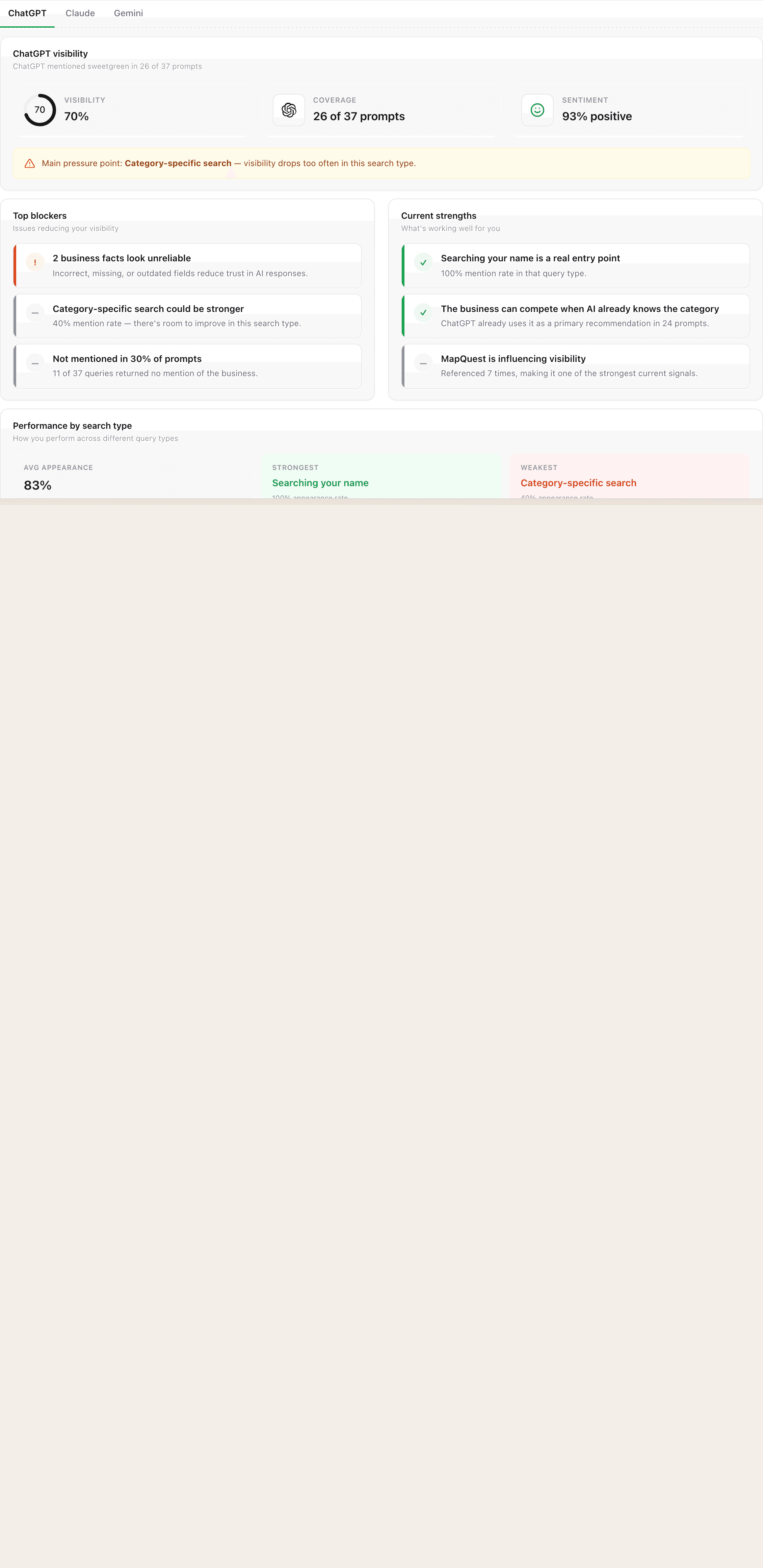
Brightwill’s audit queries all three AI engines with over 100 real prompts tailored to your business category and location. You get a breakdown per engine, per query type, with specific evidence showing exactly what each AI says about you. Run your free audit here.
How to Start Optimizing for AI Recommendations
The field of Generative Engine Optimization is still new, but the underlying principles are straightforward. If you want AI assistants to recommend your business, you need to make your business easy for them to find, understand, and trust.
Start with the basics: claim and complete your Google Business Profile, ensure your NAP data is consistent everywhere, add JSON-LD schema markup to your website, and actively solicit customer reviews. Then move to advanced strategies: get featured in industry publications, create detailed comparison content on your own site, and build the kind of comprehensive web presence that AI models draw from when they synthesize answers.
For a deeper dive into optimization tactics, read our guide on how to get recommended by ChatGPT or learn more about what GEO is and why it matters.
The Bottom Line
AI assistants are rapidly becoming one of the primary ways people discover businesses. ChatGPT uses real-time web search and draws from reviews and directories. Claude relies on its training data and favors authoritative mentions. Gemini leans on Google’s search infrastructure and Knowledge Graph. Each engine is a separate channel with its own rules.
The businesses that consistently get recommended are the ones that build strong, consistent, well-documented online presences across multiple platforms. The ones that lose are the ones who assume Google Search is all that matters.
Don’t guess whether AI is recommending your business. Check your AI Visibility Score for free and see how your business appears across all three AI search engines.